
A wallet can display a larger dollar balance while your financial position is becoming more fragile. That counterintuitive result is common in DeFi, where assets may be distributed across several EVM chains, liquidity pools, lending markets, bridges, and token contracts. The difficulty is not merely finding the numbers. It is understanding what those numbers represent, how quickly they can change, and which assumptions make them unreliable.
For US-based DeFi users, multi-chain portfolio tracking is therefore less like checking a brokerage statement and more like maintaining a live risk map. A useful system must distinguish native assets from wrapped representations, spot holdings from protocol claims, and visible balances from obligations. It should also help a user evaluate a proposed transaction before signing it. That is where advanced wallet tooling becomes consequential: security is not a separate layer from portfolio management; it is part of the same decision process.
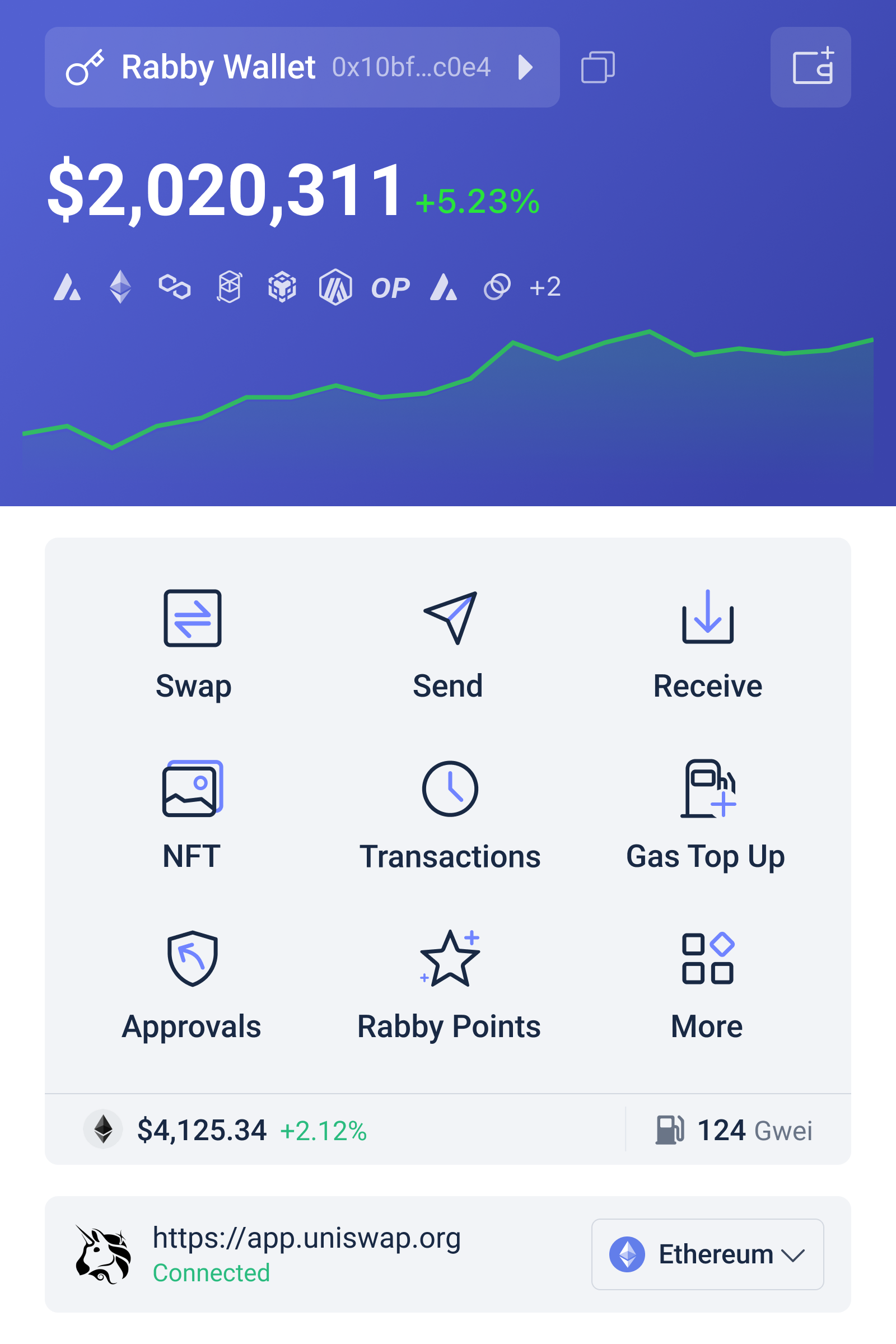
The portfolio is not the balance sheet
The first mistake in multi-chain tracking is treating every token balance as equivalent. One dollar of a liquid stablecoin held directly in a wallet is not economically identical to one dollar represented by a lending-market receipt, a bridged token, or a claim inside a liquidity pool. They may share a displayed price, but they carry different dependencies.
A direct token balance primarily depends on the token contract, the chain, and the ability to transact. A lending position adds protocol solvency, collateral rules, interest-rate changes, and liquidation conditions. A bridged asset adds assumptions about the bridge mechanism and the relationship between the original and wrapped representations. A liquidity-provider position may expose the user to price divergence, fee variability, and smart-contract risk. Portfolio software that aggregates these positions into one total can be useful, but the total is only a starting point.
This leads to a sharper mental model: portfolio value is a layered estimate, not a single fact. At the top layer is market value. Beneath it are liquidity, counterparty or protocol exposure, contract permissions, chain reliability, and the possibility that the displayed price cannot be realized at the expected size. A tracking tool that shows only the first layer may create false confidence precisely when the portfolio becomes more complex.
Why chain count can conceal concentration
Holding assets on five chains may appear diversified, yet the economic risk can remain concentrated. The same stablecoin issuer, oracle design, bridge route, lending protocol, or wallet approval may connect multiple positions. In that case, the portfolio is geographically distributed across networks but functionally dependent on a small number of components.
Consider a user who holds a dollar-pegged asset on Ethereum, an EVM-compatible layer-two network, and another chain. The addresses differ and the transaction fees differ, but the positions may still share exposure to the issuer and to the infrastructure that supports the token’s transfer and pricing. If the user supplies the asset to a lending market on one chain, the risk profile changes again: the holding is no longer simply a currency substitute but a claim mediated by a protocol.
For this reason, effective portfolio tracking should group assets in at least three ways. The first is by chain, which helps with operational questions such as gas availability and network access. The second is by economic function, separating cash-like assets, volatile assets, governance tokens, debt, and yield-bearing positions. The third is by dependency, identifying common issuers, bridges, protocols, or permissions. The third grouping is often the most revealing and the least visible in a conventional wallet balance.
Transaction simulation belongs inside portfolio analysis
Tracking tells you what you own; simulation helps test what a transaction will do to that ownership. A transaction simulation is an estimate of the resulting state before a user signs. Depending on the wallet and the transaction, it can reveal token movements, approvals, contract interactions, expected output, and changes to the wallet’s position. It cannot eliminate uncertainty, but it can expose a mismatch between the user’s intention and the transaction’s actual effects.
This matters because many DeFi losses are not caused by a misunderstood market forecast. They arise from an incorrect approval, an unexpected recipient, a malicious contract, an unfavorable swap route, or a transaction that grants broader authority than the user intended. A simulation can make those mechanics legible at the point of decision. Security warnings can add another layer by flagging suspicious contracts, risky approvals, or unusual transaction behavior.
The limitation is important. Simulation is conditional on the state and assumptions available when it runs. A rapidly changing market, a transaction ordering change, a contract with unusual behavior, an oracle update, or a failed external dependency can produce a different outcome. Simulation also does not prove that a protocol is economically sound or that its code is free from vulnerabilities. It is best understood as a pre-trade inspection tool, not an insurance policy.
For users comparing advanced wallet options, a wallet such as rabby wallet is most useful when its transaction review and security features are treated as part of a repeatable workflow rather than as a badge of safety. Before signing, the user should ask: what assets leave, what assets arrive, what permissions change, which chain is involved, and what new protocol dependency is being created?
Comparing the main approaches
Wallet-native tracking
A wallet-native view is usually the best first line of defense because it is close to the signing context. It can connect balances with the address, chain, approvals, and proposed transaction. This reduces the chance of approving an action without understanding its immediate effect. The trade-off is breadth: complex derivatives, positions inside protocols, historical cost basis, and cross-wallet activity may be represented imperfectly or not at all.
Dedicated portfolio trackers
Specialized trackers can offer stronger historical analysis, performance attribution, tax-lot organization, and broader aggregation across addresses and protocols. For an active US user, that may be valuable when estimating taxable events or reconciling activity across multiple accounts. The sacrifice is an additional layer between observation and action. Data can lag, token labeling can be wrong, and a polished dashboard may hide uncertainty in valuation or protocol classification. These tools are strongest for analysis after the fact, not necessarily for approving a transaction.
Spreadsheets and custom data pipelines
A spreadsheet or personal script offers transparency and control. The user can define categories, record assumptions, and calculate exposure in a way that fits a particular strategy. It is also the most fragile option. Contract upgrades, new chains, token migrations, changing prices, and incomplete data feeds can quietly invalidate the model. Custom systems are valuable for advanced users who understand their data lineage, but they should not be mistaken for an objective source of truth.
The practical conclusion is not that one approach should replace the others. A robust workflow can use a wallet for transaction-level safety, a tracker for aggregation and historical analysis, and a simple personal record for assumptions that automated systems cannot know. Each layer answers a different question. Problems arise when a tool designed for one purpose is treated as if it solved all three.
A reusable framework for multi-chain risk review
Before adding a new position, review it across five dimensions: value, liquidity, dependency, authority, and reversibility. Value asks how the position is priced and whether that price is observable. Liquidity asks how quickly it can be converted without material slippage. Dependency asks which issuer, bridge, protocol, oracle, or chain must continue functioning. Authority asks what permissions have been granted to contracts. Reversibility asks whether the action can be unwound if conditions change.
This framework produces better questions than “What is my total balance?” A position may have a high displayed value but low liquidity. It may be liquid but dependent on a bridge. It may be well priced but subject to an unlimited token approval. It may be profitable on paper yet difficult to reverse during network congestion or a sharp market move.
A useful operating habit is to review approvals separately from balances. An empty wallet can still be exposed if a contract retains authority to move tokens later. Likewise, a portfolio can look conservative while its largest risk is an overlooked permission rather than a volatile asset. Periodic approval review, deliberate chain selection, and transaction simulation are therefore portfolio controls, not merely technical housekeeping.
What to watch as wallets become more analytical
Recent wallet messaging has emphasized broad EVM coverage, ease of use, and security features across on-chain activity. The important development is not simply that wallets support more networks. It is that the wallet is increasingly becoming an interpretation layer between raw blockchain state and human action. If that layer improves, users may make fewer errors when interacting with unfamiliar chains and protocols.
The unresolved question is how much confidence users should place in automated interpretation. Better labeling and simulation can reduce preventable mistakes, but they may also encourage users to delegate judgment to a warning system. The value of these features will depend on clarity about uncertainty: a warning should distinguish a known malicious pattern from an unfamiliar contract, and a valuation should distinguish a liquid market price from a thin or synthetic estimate.
Conditional on wallets continuing to integrate simulation, approvals, and cross-chain exposure views, the next useful step would be risk-adjusted portfolio presentation rather than a larger balance total. Such a system might show how much of a portfolio depends on one issuer, bridge, protocol, or permission set. That would not predict failures, but it could reveal where a supposedly diversified strategy is structurally concentrated.
Frequently asked questions
Is a multi-chain portfolio automatically safer than a single-chain portfolio?
No. Multiple chains can reduce dependence on one network, but they can also increase operational complexity and introduce bridge, issuer, and protocol dependencies. Diversification should be measured by shared economic risks, not by the number of chain logos in a dashboard.
Can transaction simulation guarantee that a DeFi transaction is safe?
No. Simulation can clarify expected state changes and expose suspicious or unintended behavior, but it depends on available data and current conditions. It does not establish that a protocol is solvent, that its code is secure, or that the transaction cannot be affected by later market or network changes.
What should I check first when reviewing a new position?
Start with the asset’s economic function, then identify its issuer, protocol, chain, liquidity conditions, and contract permissions. Ask what must remain operational for the position to retain its displayed value and whether the transaction can be reversed without unacceptable cost.
The central lesson is simple but easy to miss: multi-chain portfolio tracking is not mainly a visualization problem. It is an exercise in reconstructing dependencies. A wallet balance tells you where an asset is recorded; a serious risk review asks what that asset represents, who or what it relies on, and what authority you have already granted. Once tracking and transaction review are treated as parts of one process, the portfolio becomes more than a collection of token amounts. It becomes a map of exposures, assumptions, and decisions.